Africa's Creative Economy Isn't a Culture Story Anymore. It's an Infrastructure Story.
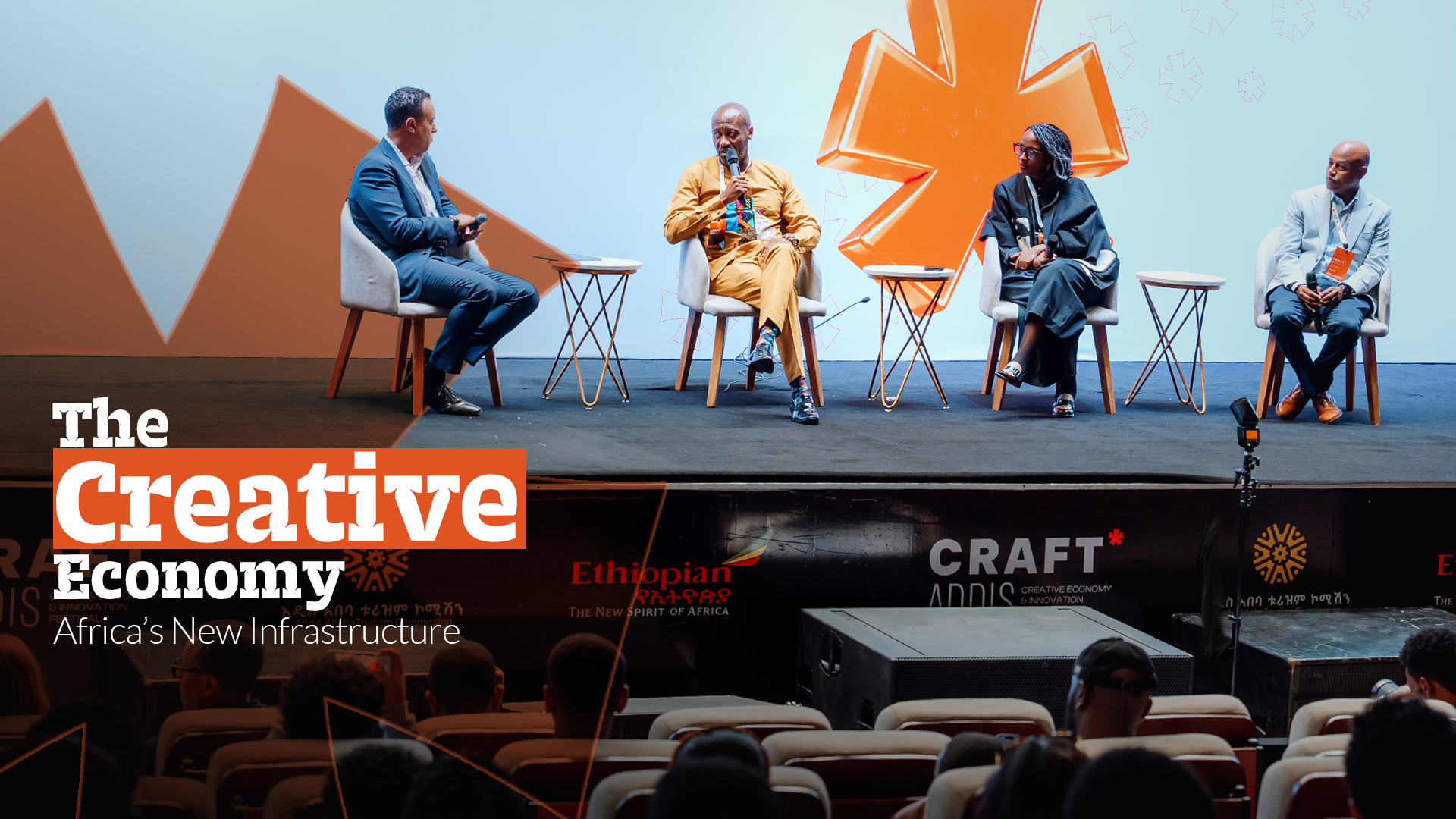
Inside the CRAFT Addis main panel: Meraf Markos, Andisa Ntsubane, Jocelyne Muhutu-Remy and Zelalem Woldemariam on the systems Africa needs to turn creativity into jobs, exports and global competitiveness.
27 Aug 2026 · 9 min read
Opening the first panel at CRAFT Addis, moderator Meraf Markos, General Manager of ALX Ethiopia, set the tone with a reframe the rest of the conversation would build on: Africa's creative industries have historically been discussed in cultural terms — the music, the fashion, the storytelling the continent is known for. That framing, he argued, is no longer sufficient.
“What we should really be discussing,” Meraf told the audience, “is infrastructure and ecosystem maturity; systems that allow creators to produce, distribute, monetize, and scale intellectual property within the continent and at a global level.” Whether Africa is creative isn't in question. Whether the continent is building the systems to convert that creativity into sustained economic power — jobs, exports, global competitiveness — is.
To dig into that, he was joined by three panelists spanning the creative value chain: Andisa Ntsubane, bringing a cross-continental view on brand, marketing, and governance; Jocelyne Muhutu-Remy, who leads Spotify's business across Sub-Saharan Africa; and Zelalem Woldemariam, founder of Zeleman Communications, one of Ethiopia's leading creative enterprises spanning advertising, production, and storytelling.
The scale is real. The capture isn't there yet.
Andisa opened with the numbers. The IMF puts the global creative services industry at roughly $2 trillion. Within that, Africa's individual sectors are growing quickly: fashion was worth around $35 billion in 2020 and is projected to reach $50 billion by 2030; film sits at $5 billion today, headed toward $20 billion and 20 million jobs by the same year; gaming is the fastest-growing market in the world; music and visual arts, while smaller in absolute terms, are climbing too.
But measured against global growth, the picture sobers quickly. Africa doesn't yet represent even 3% of the global value of the creative industry, and contributes only around 5.4% of the world's books and publishing market — despite the continent's claim to being a center of storytelling. The task ahead, in his words, is to “harness all stakeholders within the ecosystem to capture a greater share of that global market.”
Streaming solved discovery. Monetization is still catching up.
Jocelyne brought the platform perspective and a personal one. Born and raised in Addis, she opened by reflecting on how dramatically the city has transformed since her childhood, and framed that same kind of transformation as the ambition for the creative industry, and for music in particular.
Since 2021, African music has been among the fastest-growing music markets in the world, alongside Latin America and the Middle East — a significant shift for Spotify, which counts close to 800 million users globally and sees the continent's youth dividend as central to its growth strategy. Spotify's role, she explained, sits at the distribution layer:
Before streaming, you could sing all you wanted in your corner, but it took a lot for someone in Tokyo or Bolivia to discover your music. Right now, it takes exactly a second to be discovered. — Jocelyne Muhutu-Remy
Ethiopia's own experience proved the point. Spotify launched quietly in the market roughly two years ago, expecting slow growth; instead, adoption spread fast through word of mouth. What hasn't caught up yet is monetization. Jocelyne walked through the chain: a listener needs an enabled smartphone; a regulatory environment that allows purchasing a foreign digital service; and, on the other end, strong local labels and distributors able to receive and redistribute revenue back to rights holders. In Ethiopia, payment hurdles mean most listeners currently use the free, ad-supported tier rather than subscribing. Spotify has already redistributed tens of millions of dollars to the music industry in markets like Nigeria, South Africa, and Kenya; the goal is to see the same in Ethiopia.
Her advice in the meantime: don't wait for the ecosystem to be perfect. Diaspora audiences are an immediately available lever. The Nigerian diaspora in the US and UK played a significant role in accelerating Afrobeats' global rise, and Ethiopia's own large diaspora represents a similar, largely untapped opportunity.
Monetization starts as a mindset, not a feature
For Zelalem, the creative arts sector — spanning advertising, film, fashion, gaming, architecture, and more — has long been celebrated culturally while struggling to capture real value, held back by infrastructure, policy, and technology constraints. But he was direct about where responsibility also sits: with creators themselves.
It's not just followers who make you financially strong; it's the community you're building. — Zelalem Woldemariam
Monetization, in his framing, starts in the mind: knowing what you want, understanding your value chain, securing your IP, and building an actual system — a team, partners, platforms — around your creative output. He pointed to his own experience watching fellow filmmakers twenty years ago who never figured out how to build a business around their craft, while others did. The difference wasn't talent. It was structure.
Spotify's own economics reinforce the point from the platform side: when the model works, roughly 70% of subscription revenue flows back to the creator. Getting every market to that point is the work ahead.
Access is the real infrastructure layer
The conversation widened when Andisa was asked whether Africa's creative sectors are forming into mature industries or still operating as fragmented pockets of excellence. His answer reframed the entire opportunity: Africa's scale of problems is itself the opportunity. Of the continent's 1.5 billion people, around 600 million still lack access to electricity, let alone network connectivity.
Drawing on his experience in telecom, he described the deliberate work of rolling out network access in Ethiopia — three years of investment resulting in 12 million new customers gaining internet and data access for the first time — alongside mobile money infrastructure and, critically, device financing. Smartphones remain expensive relative to income across much of the continent, and creative solutions are emerging to close that gap: in South Africa, for example, a product called “Easy to Own” lets customers fund a smartphone through daily airtime purchases of less than a dollar.
His broader point: African marketers and brand builders are, in his view, among the best in the world precisely because they're solving harder problems than their counterparts elsewhere.
For far too long we've always said we need to look to the world, but actually, the world needs to look to us. — Andisa Ntsubane
What it actually takes to build a creative business
Asked what it takes to turn creativity into a repeatable, revenue-generating business — drawing on his own experience building one of Ethiopia's most scaled creative enterprises — Zelalem was blunt: it requires understanding business structure, customers, team-building, and the policy environment, and it requires resilience. Creators who resist the “paperwork” side of the business can still create, but they won't scale. It's a decision every creator has to make consciously.
Jocelyne added the distribution-and-data angle, drawing on her prior experience at MTV and Facebook. The foundation — creativity itself — is fully established and abundant across the continent. What's needed on top of it is infrastructure: stronger label ecosystems, better IP protection, and above all, the connection between artist and audience. Social media has changed that connection dramatically; a creator can build a following from anywhere and reach millions. Spotify's own role includes actively promoting African artists globally, from billboards in Times Square and London to curated playlists that connect an artist in Addis to an editor in Berlin.
But the ultimate goal, she noted, isn't necessarily export. “The ultimate, ultimate aim is to not need to export at all. You can just reach audiences even in your city and make a living.”
Africa is not one market
Asked what prevents African creative brands from scaling across the continent — even before considering global markets — Andisa offered a clear answer: Africa is not a country, and treating it like one is a recurring, costly mistake. He illustrated with an example from financial services: a funeral policy product built around a 12-hour payout promise won the number-one market position in South Africa, but the same proposition fell flat in Nigeria, where religious and cultural burial customs mean payout speed isn't the primary value driver. Brands that assume what works in one market will work everywhere, he noted, are often the ones that eventually exit the continent altogether.
He also pointed to connectivity — both physical and administrative — as a quiet but critical enabler, citing his own experience of a 10-minute online visa approval in Ethiopia as an example of infrastructure improvements that are becoming table stakes for growth.
His closing story was a sharp one: in the 1930s, two Dutch shoe companies sent sales representatives to Uganda. One reported back, “I'm coming home, nobody wears shoes.” The other said, “Bring everybody; we're going to open a factory here, nobody wears shoes.” Same market, opposite conclusions. “The challenge to us,” he said, “is how do we not let people overseas see opportunities here when we are here.”
What Afrobeats, Nollywood, and K-pop got right
Closing out the panel, Meraf asked each speaker a forward-looking question. Asked what globally successful industries like Afrobeats, Nollywood, and K-pop got right, Jocelyne pointed to a consistent formula:
- Leveraging diaspora audiences.
- Staying authentic rather than imitating other markets.
- Being relentlessly productive.
- Marketing boldly and loudly.
She's already seeing early signs of the same pattern with Ethiopian artists. She also used the moment to push back directly on two persistent myths about African consumers: that data costs prevent meaningful streaming consumption (Africa in fact shows among the highest music consumption levels of any emerging market), and that consumers won't pay for digital services — when pricing, product, and payment methods are right, African consumers are, in her words, “as discerning as any other consumer,” and they do purchase.
AI, and the next structural shift
Asked to name the one structural shift that needs to happen in the next three to five years to move Africa from cultural influence to economic power, Andisa didn't hesitate: AI. He described using generative tools like Google Veo to produce a 30-second TV commercial in 30 minutes, and using AI voice technology to let a single recorded session stand in for a voiceover artist's full body of future work. The implications for the entire production and advertising value chain are significant — and unavoidable.
People talk about the power of technology to change Africa. I say no; we must talk about the power of Africa to influence technology, and make it relevant for our context and our markets. — Andisa Ntsubane
His call to the room was to lean into AI rather than fear it.
The last word
Closing the session, Meraf asked Zele to finish a sentence: “In five years' time, CRAFT Festival will be known as…”
The biggest creative economy and innovation platform in the world. — Zelalem Woldemariam
A bold note to end on and, fittingly, exactly the kind of ambition the panel had spent the last hour arguing the continent's creative economy deserves.
Watch the full opening panel
Explore the complete 40+ minute dialogue on platform power, connectivity and creative legacy.
Watch the full session on CRAFT YouTube
This article is based on the opening panel discussion “The Creative Economy: Africa's New Infrastructure” at CRAFT Addis, moderated by Meraf Markos (General Manager, ALX Ethiopia), featuring Andisa Ntsubane, Jocelyne Muhutu-Remy (Spotify, Sub-Saharan Africa), and Zelalem Woldemariam (Zeleman Communications).